
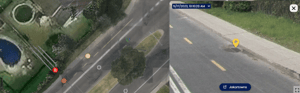
🕳️ How a Digital Twin Revealed 300 Missing Catch Basins in a Quebec City
🎯 The problem no one saw coming
For seven years, a city maintained only half of its stormwater infrastructure.
Not because of budget cuts.
Not because of poor planning.
But because half of the assets had disappeared from the inventory.
When the digital twin was created, the city made a surprising discovery:
They thought they had 300 catch basins.
They actually had 600.
🏙️ A familiar reality for many cities
This story comes from a small municipality in the Laurentians region of Québec, with about 15,000 residents and roughly 200 km of roads.
Like many cities of its size, infrastructure inventories had historically been managed using:
- Excel spreadsheets
- paper documents
- internal knowledge passed between employees
The information existed — but it was fragmented, incomplete, and not centralized.
In 2023, the city decided to modernize its data management and created a geomatics department.
One of their first initiatives was to build a digital twin of the city and generate infrastructure inventories using mobile LiDAR data.
Among those inventories was a catch basin and manhole inventory.
🔍 “There must be a mistake”
When the inventory was delivered, the city team quickly reached out.
According to their internal records, the city had around 300 catch basins.
The digital twin identified close to 600.
Their first reaction was natural:
"There must be an error."
But after validating the data with field crews and internal teams, the conclusion became clear.
The digital twin was correct.
📜 A maintenance plan… lost in time
Back in 2016, the city had implemented a practical maintenance strategy.
Instead of cleaning all catch basins every year, they divided the network in two:
- 300 basins cleaned one year
- 300 the following year
This created a two-year maintenance cycle.
But in 2017, the employee responsible for the program left the organization.
The replacement employee inherited the maintenance list — but only half of it.
Without realizing it, the team continued cleaning the same 300 basins every year.
For seven years, the other half of the network received no maintenance.
⚠️ The real issue: invisible infrastructure
The problem was not operational.
It was informational.
The city didn’t lack infrastructure.
It lacked a reliable and centralized inventory of that infrastructure.
When infrastructure knowledge lives in:
- spreadsheets
- paper files
- or employee memory
it becomes vulnerable to staff turnover and information loss.
🛰️ What the digital twin changed
When the digital twin was created, the entire stormwater network became visible instantly.
For the first time, the city had:
- a complete geospatial inventory
- a verified count of assets
- a centralized system accessible across departments
The result wasn’t just better data.
It was operational clarity.
🌍 A lesson for every municipality
Many cities assume their infrastructure inventories are complete.
In reality, these inventories often evolve over decades across multiple systems, departments, and employees.
The result can be:
- missing assets
- outdated records
- inconsistent maintenance cycles
A digital twin provides something surprisingly simple but powerful:
a single, reliable picture of the city’s infrastructure.
🚀 Sometimes innovation simply begins with visualizing what already exists.
When people hear “digital twin,” they often think of AI, simulations, or predictive analytics.
But sometimes the first impact is much simpler.
It’s about finally seeing your city clearly.
In the case of that city, that clarity revealed 300 catch basins that had quietly disappeared from the records — but were still there in the ground.
And once you can see your infrastructure,
you can finally manage it properly.

COMMENTS